
Incident Management.
Singlepoint Incident Manager provides an end-to-end approach to Environment, Health and Safety (EHS) incident management. Make it easy for your workforce to report accidents, incidents, near misses and hazards, while maintaining the visibility, evidence and traceability needed to manage each event through to closure.
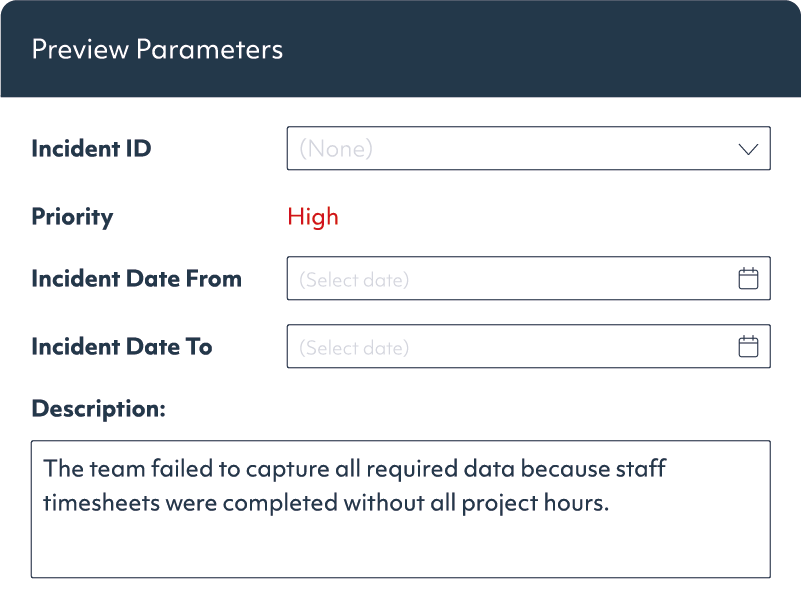
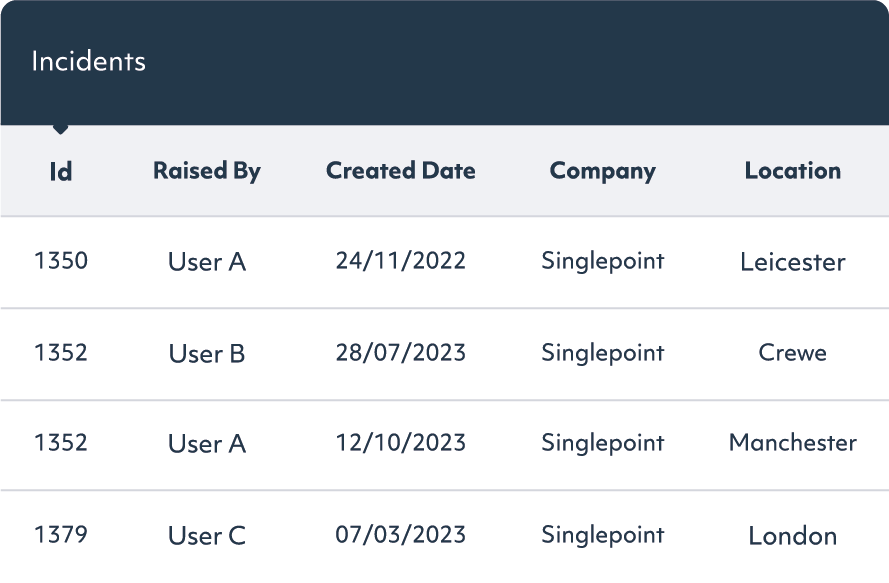
Manage incidents from report to resolution
With Singlepoint Incident Manager, your people have the right tools to get the job done. Users can quickly report accidents, incidents, near misses and hazards through the Singlepoint Incident App from any location and device.
Make safety a priority
Managers can receive, track and manage incidents, associated follow-up tasks and supporting evidence all the way through to closure. This creates a structured process for responding to safety events, with clear visibility of what has happened, what action is required and who is responsible.

Reduce business risk
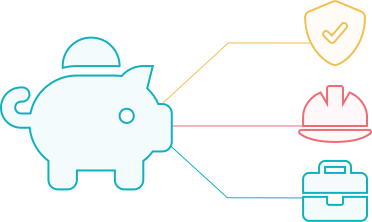
Alongside supporting your people, Singlepoint Incident Manager can help protect your business by improving how workplace incidents and accidents are managed. Consistent reporting and follow-up help teams identify risks, take appropriate action and reduce the potential operational and financial impact of safety events.
Engage everyone with safety
Singlepoint's intuitive design and accessible Incident App make it easier for employees to participate in safety processes rather than leaving incident reporting solely to managers. Combined with workflow management, this helps organizations capture information from across the workforce and use it to support continuous improvement.
Report in real-time
Singlepoint’s digital workflow carries the issue to the right team member instantly. All responsible users receive real time notifications so no time is wasted responding to the problem.
End-to-end process management
Manage the entire process from initial report through to closure, including task management, notifications and reminders. Responsible users can track follow-up actions and supporting evidence as the incident progresses, with a comprehensive audit and evidence trail created automatically throughout the process.
Integrated reporting
Access real-time incident data through Singlepoint Business Intelligence, giving managers greater visibility into incidents and the actions that follow. Identify trends, recurring risks and areas for improvement, and use those insights to target actions where they can have the greatest impact.
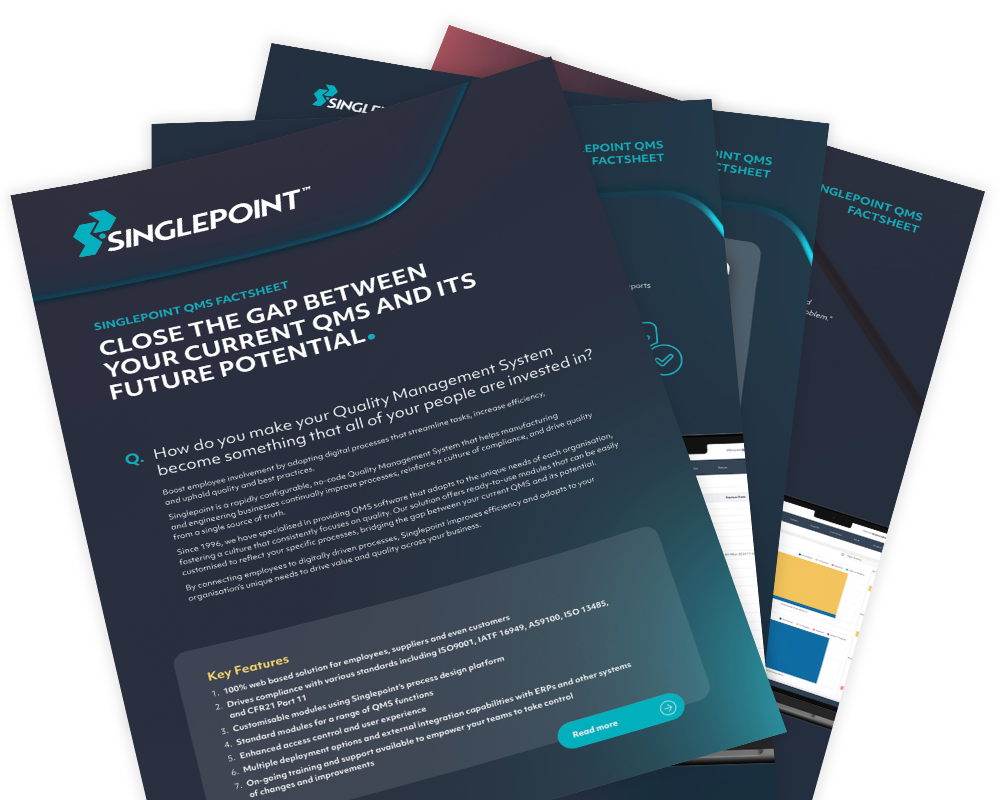
Get our QMS fact sheet
Download our fact sheet to learn more about how Singlepoint’s quality management software can help you.
Our case studies

Surface Transforms: Document Control and Training Management
Thanks to Singlepoint, Surface Transforms has significantly upgraded their document control and safety processes. The software has catalysed a paperless revolution on the shop floor, instilling greater confidence in their operational practices.

Doncasters Trucast: Business Intelligence enhances efficiency
Singlepoint Business Intelligence has redefined data interaction for Doncasters Trucast, giving staff and managers instant insight into manufacturing performance
Fablink: NPI and APQP
Fablink redefines project management in the automotive industry with Singlepoint, gaining total visibility into NPI and APQP tasks
ZF: Document Control and Management
ZF revolutionises document management with Singlepoint, leading to significant time savings and risk reduction.

Teleflex: Customised complaints module enhances global operations
Senior Quality Engineer Tineke Soors praises Singlepoint for transforming Teleflex’s customer complaint handling, making it more efficient and transparent.

Pactrol: Customised workflows streamlining cross-border operations
Explore the journey of Pactrol Controls Ltd as they navigate the challenges of relocating manufacturing to Hungary while maintaining operational excellence.

United Language Group: Achieving global compliance with Competency Checker
Facing challenges with the new QMS standards, United Language Group successfully integrated the Competency Checker module alongside existing modules.
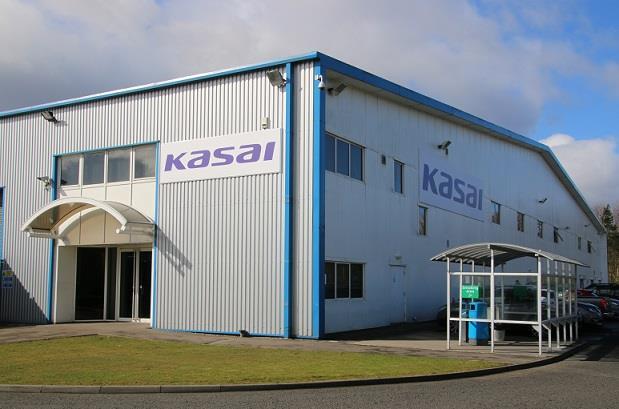
Kasai: Improving Engineering Change Processes
Kasai, a global front-runner in automotive interior and exterior manufacturing, faced challenges with its engineering change process that revolved around complex spreadsheets and scattered communications.
Metrol: Calibration Manager
Metrol Technology’s journey with Singlepoint’s Calibration Manager is a testament to the power of a single source of truth. Witness a transformation marked by efficient workflows, user empowerment and the unmatched versatility of Singlepoint.

Bandvulc: From disjointed audits to streamlined efficiency
Hitachi Rail Europe, Ltd. is a wholly owned subsidiary of Hitachi, Ltd. and a total railway system supplier offering rolling stock, traction equipment, signalling, traffic management systems and maintenance centres.
FAQs
What is the difference between EHS incident management software and IT incident management tools?
Environment, Health and Safety (EHS) incident management software is designed for workplace health, safety and environmental events, including accidents, near misses and hazards. IT incident management tools focus on technology service disruptions, system outages and technical support processes. EHS incident management software also supports activities such as investigations, corrective actions, evidence management and safety reporting.
What should a health and safety manager look for when choosing incident management software for a manufacturing or industrial business?
A health and safety manager should look for software that supports incident reporting, investigations, corrective actions, risk assessments, workflow automation, reporting and regulatory compliance. For regulated manufacturers, traceability and the ability to maintain a clear audit trail are also important. Integration with wider EHS and quality processes can help ensure incidents and resulting actions are managed consistently through to closure.
What information should a workplace incident report capture to support investigation and regulatory reporting?
A workplace incident report should record who was involved, what happened, when and where it occurred, any injuries sustained and the immediate actions taken. It should also capture contributing factors and supporting evidence such as photographs or witness statements. Maintaining this information in a controlled record supports subsequent investigation, corrective actions and regulatory reporting where required.
How does incident management software support OSHA recordkeeping and reporting requirements?
Incident management software can support Occupational Safety and Health Administration (OSHA) recordkeeping and reporting by helping organizations consistently capture workplace incident and injury information, maintain investigation records and retain supporting evidence. Centralized records can make it easier to identify incidents that may be subject to OSHA requirements and access the information needed for recordkeeping or reporting. OSHA has specific criteria determining which injuries and illnesses are recordable, while severe incidents are subject to separate reporting requirements.
How does incident management software support ISO 45001 clause 10.2 requirements for incident investigation and nonconformity management?
Incident management software can support ISO 45001 clause 10.2 through structured processes for incident recording, investigation, root cause analysis, corrective actions and effectiveness reviews. Audit trails and supporting evidence help organizations demonstrate how incidents and nonconformities have been addressed and what actions have been taken to prevent recurrence.
We had a serious workplace accident and OSHA has requested our investigation records. What documentation can an incident management system provide?
An incident management system can provide records such as the original incident report, investigation findings, photographs, witness statements, risk assessments and corrective actions. It can also maintain a traceable history of tasks and follow-up activity, helping teams retrieve relevant evidence during an OSHA inspection or investigation. OSHA requires covered records to be made available to authorized government representatives when requested.