Risk Management.
Singlepoint Risk Manager helps you proactively manage and mitigate risk through a structured, automated process. Assess and evaluate a wide range of potential risks, implement appropriate controls and maintain greater visibility over your risk profile.
Take control of your risk management
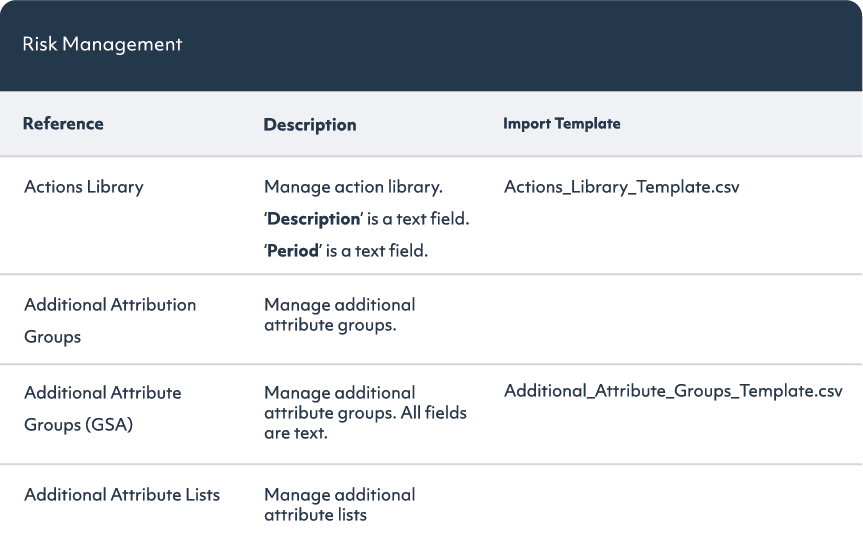
With Singlepoint Risk Manager, you can take control of your organization's risk profile and maintain a structured approach to identifying, assessing and managing potential threats across your operations.
End-to-end visibility
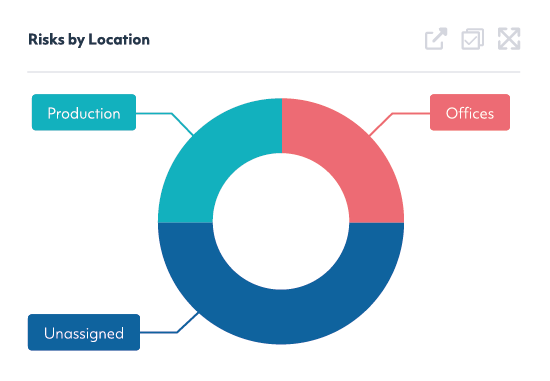
Gain greater visibility into potential risks and the controls and actions used to address them. Singlepoint keeps risk information together, making it easier to understand your current risk profile and see where further action may be required. With clearer oversight of risks across your operations, you can maintain greater control over critical areas and make more informed decisions about where to focus your risk management efforts.
Decrease risk at every stage
De-risk key processes by identifying potential issues, applying appropriate controls and managing the actions needed to address them. Rather than treating risk assessment as a one-off exercise, Singlepoint helps you maintain visibility as risks and controls change over time. This supports a safer, more controlled working environment and helps prevent identified risks from being overlooked as processes progress.
Rapid risk evaluation
Singlepoint Risk Manager offers a fully automated approach to risk assessment, helping you easily and efficiently evaluate potential risks. Bring risk information into a structured process so teams can assess individual risks, understand their significance and determine the controls or actions required.
Support established risk management methods
Singlepoint Risk Manager is designed to support industry-standard risk management methodologies, giving teams a structured approach to identifying, evaluating and addressing risks. This helps you apply your chosen risk management methods consistently while maintaining the information, controls and actions associated with each individual risk.
Embrace continuous improvement
Unlike traditional stand-alone risk assessment documents, each risk record in Singlepoint is a "living" record. You can regularly assess and evaluate risks as processes or circumstances change, review the controls already in place and identify where further action is needed.
Seamlessly manage tasks
Singlepoint offers comprehensive task management with automatic notifications, reminders and escalation. Actions can be assigned to the appropriate team members and tracked through to completion, giving you clear visibility of outstanding work.
Turn risk data into insight
Singlepoint Risk Manager integrates with Singlepoint Business Intelligence, giving you greater visibility into the data generated through your risk management processes. Use real-time reporting to identify trends, recurring risks and areas where additional controls or improvements may be required.
Get our QMS fact sheet
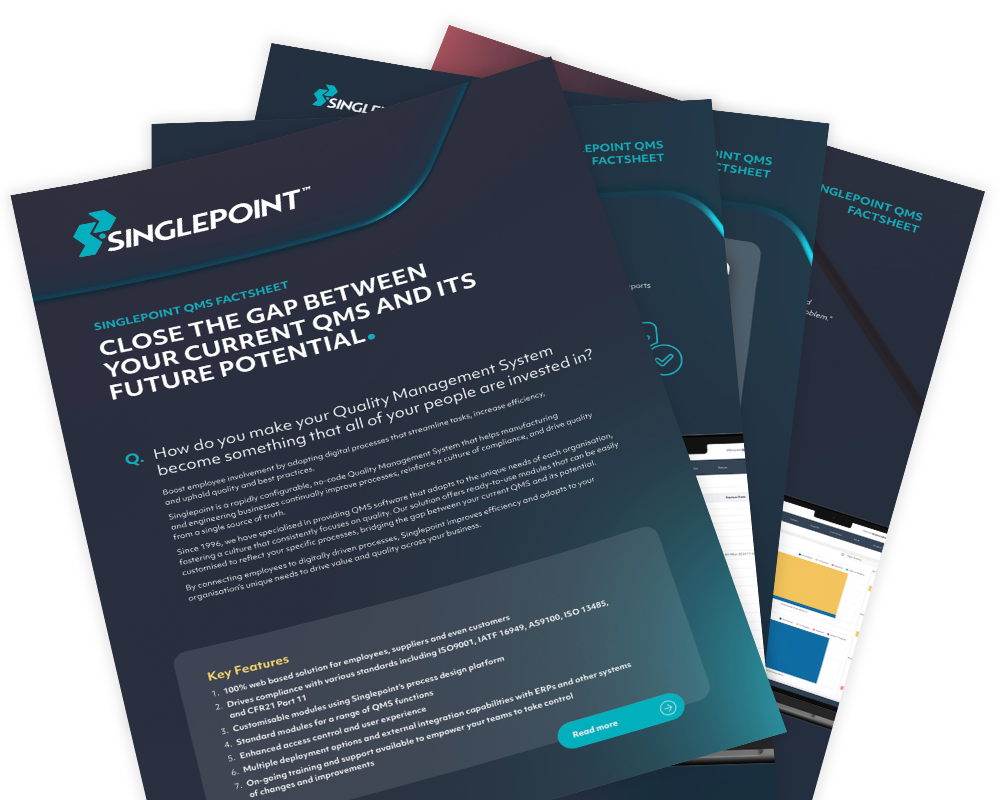
Download our fact sheet to learn more about how Singlepoint’s quality management software can help you.
Our case studies
Horizons: From barely visible to ISO 9001 audit-ready
Horizons Incorporated had a document control system, but adoption never spread beyond the core quality team. At audit the answer was technically yes; in practice, most of the workforce did not know it existed. After evaluating six vendors, Horizons chose Singlepoint for its concurrent user licensing, visual navigation, and cross-module traceability. A back-end migration from Waypoint kept implementation to weeks, not months. The result: whole-workforce access without per-seat cost, a complete corrective action audit trail, and a first surveillance audit that impressed an examiner the team had never met. Adoption itself now serves as a live quality signal.
Doncasters Trucast: Strengthening NPI & Audit Governance
Doncasters Trucast, a recognised leader in precision investment castings and turbine components, needed to strengthen governance and traceability within its New Product Introduction process. Operating in highly regulated mobility and aerospace-related markets, the business required a more structured, auditable and scalable approach to gated project management. By implementing Singlepoint’s configurable NPI module, Doncasters Trucast introduced electronic gate approvals aligned to regulatory standards, improving visibility, accountability and compliance. The result has been sustained zero audit findings related to NPI for over three years, alongside reduced administrative burden and improved real-time insight for engineering, quality and customer-facing teams.
FMP: Delivering 4,000 Hours of Efficiency Gains
FMP, one of the UK’s leading manufacturers of medical devices and healthcare products, needed to replace its manual, paper-based processes with a more efficient, compliant system. After evaluating 15 platforms across two review cycles, Singlepoint stood out as the clear leader for its flexibility, scalability and ease of use. By implementing Singlepoint’s document management and training modules, FMP achieved measurable time savings of 4,000 hours per year and significantly improved audit readiness.
Faltec: ERP Integration and Audit Efficiency
Faltec Europe streamlined operations and enhanced compliance by replacing outdated systems with Singlepoint. Discover how seamless ERP integration and centralised document management transformed their digital workflow.
UTAC: Driving Quality and Efficiency with Integrated Quality Management
UTAC UK, a leading provider of powertrain and engine testing services, faced challenges with outdated paper-based quality management processes. Senior Manager Peter Davies sought a modern, integrated solution to streamline operations across multiple sites. By implementing Singlepoint’s adaptable platform, UTAC UK digitised their entire quality management system, including document control, auditing and risk management
HiiROC: Streamlining Quality Management for Rapid Business Growth
“My rule of thumb is if my boss can find what they are looking for quickly, then the system works. With Singlepoint, anyone can now find documents in a few clicks. It has made things very easy for everyone” Keith Renouf, Head of HSEQ.
Amcor: Document Management
“Singlepoint is a very good system for control of documentation. You have everything on the system and it’s user-friendly. Everybody in the company can use it.” – Irene, Quality Systems Manager
Mentholatum: audit-ready under FDA scrutiny
The Mentholatum Company, a US OTC and consumer health manufacturer regulated under cGMP and 21 CFR Part 11, was managing quality documentation on local servers and network drives, with no single system of record, no reliable audit trail, and real exposure to ransomware. After a recommendation from its UK affiliate, Mentholatum deployed Singlepoint for document control across its Orchard Park and Horsham sites. A 2026 cloud migration removed dedicated server hosting and saved over $18,000 a year, while delivering 24/7 access for a three-shift operation. Every operator can now pull up a current, controlled SOP the moment an auditor asks.

Hitachi Rail: Multi-site implementation
Hitachi Rail Europe, Ltd. is a wholly owned subsidiary of Hitachi, Ltd. and a total railway system supplier offering rolling stock, traction equipment, signalling, traffic management systems and maintenance centres.

Gates Power Systems: Visual Navigator
Gates Power Systems enhanced their document management with Singlepoint’s Visual Navigator, linking ‘hotspots’ to manufacturing equipment images for precise document access.
FAQs
What is RAMS (Risk Assessment Method Statement), and how does risk management software help create and manage them?
A Risk Assessment Method Statement (RAMS) combines a risk assessment with a method statement to document potential hazards, the controls in place and how work should be carried out safely. Risk management software can help teams create, approve, review and maintain these documents within a controlled process. It also provides greater visibility over reviews and actions, helping keep risk information current as requirements or working conditions change.
What is a risk register, and why can managing one in a spreadsheet create compliance risks?
A risk register records identified risks alongside information such as controls, owners and review dates. Managing this information in spreadsheets can create challenges around version control, visibility and accountability, particularly as the number of risks and users increases. Dedicated risk management software provides a more structured way to manage records, actions and reviews while maintaining traceability.
What is the difference between risk management software and a Governance, Risk and Compliance (GRC) platform?
Risk management software focuses on identifying, assessing, controlling and monitoring operational risks. A Governance, Risk and Compliance (GRC) platform typically covers a broader range of governance, enterprise risk and compliance activities. The right approach depends on your organization’s requirements and the scope of the risks and compliance processes you need to manage.
How does Singlepoint Risk Management work with incident management and audit management in an integrated EHS system?
Singlepoint Risk Management works alongside incident and audit management within the wider Singlepoint platform. Risks can be linked with incidents, audits, corrective actions and investigations, providing greater visibility across related Environment, Health and Safety (EHS) processes. This helps teams understand where controls may need to be reviewed and supports continuous improvement.
How does risk management software support ISO 45001:2018 clause 6.1 requirements for hazard identification and risk assessment?
It provides structured processes for identifying hazards, assessing risks, implementing controls, and maintaining records. This helps demonstrate a consistent and documented approach to risk management.
We are a manufacturer preparing for ISO 45001 certification and currently manage our risk assessments in spreadsheets. What would moving to dedicated risk management software change?
Moving from spreadsheets to dedicated risk management software centralizes risk assessments and provides structured processes for reviews, actions and reminders. It can improve visibility across risks, maintain a traceable history of activity and make it easier to identify outstanding actions. This also gives teams more accessible evidence of how risks are being managed when preparing for an ISO 45001 certification audit.